

Chanderbhan Psychological Services
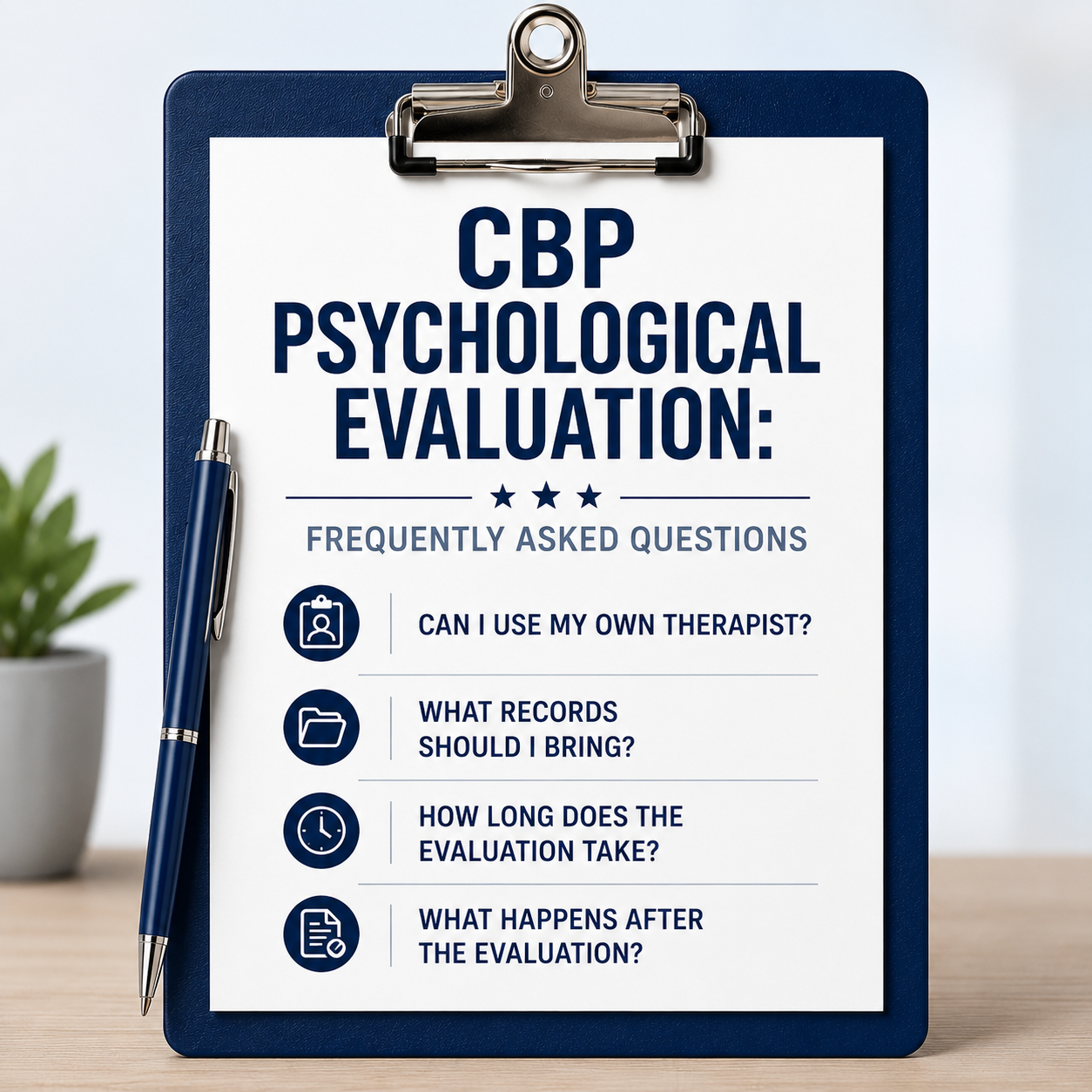
Many applicants are asked to complete a CBP pre-employment psychological evaluation due to prior mental health treatment in their records. In those cases, CBP may request a CBP psychological evaluation to better understand the applicant’s mental health history and determine whether they can safely perform the duties of the position.
Receiving this request can feel stressful or confusing. Many applicants are unsure what the evaluation involves or what information CBP is looking for. In this post we explain how the process generally works and what applicants should expect.
It’s important for applicants to understand that the psychologist’s role is to provide an independent clinical assessment based on testing, records, and the clinical interview, while CBP is ultimately responsible for all hiring decisions.
Why CBP Requests Psychological Evaluations
CBP officers work in high-responsibility positions that require sound judgment, emotional stability, and the ability to handle stressful situations.
When prior mental health treatment appears in an applicant’s background, CBP may request additional evaluation to better understand:
the nature of the prior mental health condition
the current level of functioning
whether symptoms are stable or resolved
whether the applicant can safely perform essential job duties
This evaluation is not automatically a negative sign. In many cases it simply allows CBP to obtain additional clinical information before making a hiring decision.
The CBP Psychological Evaluation Process
A typical CBP psychological evaluation involves several steps.
Psychological Testing
Applicants first complete standardized psychological testing in our office. These tests measure psychological symptoms, personality characteristics, and emotional functioning.
The testing portion typically takes about one hour and must be completed in person.
Record Review
The evaluating psychologist carefully reviews all available documentation related to the applicant’s mental health history. This may include prior therapy notes, medication records, hospital records, or other relevant documents.
Complete records are very important. Evaluations are more thorough if the examiner has reviewed the full set of available records.
Clinical Interview
After testing and record review, the psychologist conducts a clinical interview with the applicant. This interview usually lasts between 70 and 85 minutes.
During the interview the psychologist discusses the applicant’s history, current functioning, and any prior mental health treatment.
Report Preparation
After the evaluation is complete, the psychologist prepares a formal report addressing the specific questions CBP has asked about the applicant’s mental health and fitness for duty.
The report is then provided to the applicant for submission to CBP.
Choosing an Evaluator
CBP's psychological evaluation forms indicate that applicants should be evaluated by a psychologist or psychiatrist and note that experience conducting law enforcement or public safety psychological evaluations is preferred.
These evaluations differ from therapy, medication management, or routine mental health treatment. The evaluator must be able to review records, interpret psychological testing, assess job-related psychological functioning, and address the specific questions CBP has asked.
Applicants may wish to ask potential evaluators about their experience conducting pre-employment psychological evaluations for law enforcement, public safety, or related positions before scheduling an appointment.
Applicants occasionally seek evaluations from clinicians who are unfamiliar with CBP's requirements. This can sometimes result in delays if the report does not fully address the information CBP has requested.
Why Mental Health Records Are Important
One of the most important parts of a CBP psychological evaluation is the review of prior mental health records.
These records help the evaluator understand the context of prior treatment and determine whether symptoms have improved or resolved.
Applicants are strongly encouraged to gather their records as early as possible in the process. Records should be submitted prior the initial appointment or brought to the initial appointment.
Additional Documentation
The specific records needed for a CBP psychological evaluation vary from applicant to applicant and depend on the individual's history.
Examples of records that may be requested include prior therapy records, psychiatric treatment records, hospitalization records, medication management records, or other documentation relevant to an applicant's mental health history.
Applicants who have received mental health treatment through the VA or who have a service-connected mental health condition may also need to obtain related records.
Because obtaining records can take time, applicants are encouraged to begin gathering documentation as early as possible.
Timeline for the Evaluation
Most CBP psychological evaluations are completed within approximately two to three weeks after all records are received and the testing and interview have been completed.
Because gathering records can take time, applicants are often encouraged to request an extension from CBP if needed.
Important Things Applicants Should Know
It is important to understand that a CBP pre-employment psychological evaluation is different from therapy.
The psychologist's role is to conduct an objective assessment and answer the specific questions CBP has asked about the applicant's mental health and job functioning.
Even though the applicant pays for the evaluation, the psychologist's role is to provide an independent professional opinion based on psychological testing, records, and the clinical interview.
The evaluator does not make the hiring decision. Rather, the evaluator provides information to CBP, and CBP ultimately determines whether an applicant meets hiring requirements.
For that reason, the outcome of the evaluation is not guaranteed and must be based on the available clinical information.
CBP Psychological Evaluations in Laredo, TX
At Chanderbhan Psychological Services, we conduct CBP psychological evaluations in Laredo, TX for applicants who have been asked to complete a mental health assessment as part of the hiring process.
Dr. Chanderbhan has experience conducting law enforcement pre-employment psychological evaluations and is familiar with the documentation and issues commonly addressed in CBP psychological evaluations.
If you have been asked to complete a CBP psychological evaluation and would like to learn more about the process, you can contact our office through the Contact Form on our website. Our staff can walk you through the next steps and answer your questions.otal sleep and recovery over time.
Note: Because CBP's hiring requirements and procedures can change over time, applicants should refer to official CBP communications regarding their specific case. The information in this article is intended to provide general educational information about the psychological evaluation process based on the author's experience conducting these evaluations and does not represent CBP policy, hiring criteria, or hiring decisions.
-
CBP may request a psychological evaluation if prior mental health treatment appears in an applicant’s records. The purpose is to better understand the applicant’s mental health history and determine whether they can safely perform the job duties required for the position.
-
The testing appointment usually takes about one hour, and the clinical interview lasts about 70 to 85 minutes. There’s also a 30 minute feedback session. Once all records are received and the evaluation is complete, the report and forms are typically prepared within a few weeks.
-
It depends on CBP's requirements and the qualifications of the provider. In general, a CBP psychological evaluation is different from therapy and differs from a routine mental health evaluation.
CBP's forms indicate that it’s preferable that applicants be evaluated by a psychologist or psychiatrist and note that experience conducting law enforcement or public safety psychological evaluations is preferred. Applicants may wish to ask potential evaluators about their experience conducting pre-employment psychological evaluations before scheduling an appointment.
-
The records needed vary depending on an applicant's history and the specific questions CBP has asked.
Examples of records that may be requested include therapy records, psychiatric treatment records, hospitalization records, medication management records, and other documentation relevant to an applicant's mental health history.
Applicants who have received treatment through the VA or who have a service-connected mental health condition may also need to obtain related records. Because obtaining records can take time, applicants are encouraged to begin gathering documentation as early as possible.
-
Veterans who have received mental health treatment or who have service-connected mental health conditions may be asked to provide additional information as part of the evaluation process.
The purpose of the evaluation is to provide CBP with relevant clinical information regarding an applicant's history, treatment, and current functioning.
Depending on an individual's circumstances, this may include treatment records, disability documentation, or information from treating providers.
CBP ultimately determines whether an applicant meets hiring requirements and makes all final hiring decisions.