

Chanderbhan Psychological Services
Why Do I Worry So Much? Understanding Anxiety and the Emotions Beneath It
In this month’s post about depression, we talked about the important role emotions play in our lives. In this post, we take a look at one of the most common experiences people have with anxiety: worry. People who struggle with anxiety often ask, “Why do I worry so much?" or "Why can't I stop overthinking?" Chronic worry is actually one of the most common symptoms of anxiety.
Most of us who struggle with anxiety start to take our constant worry for granted, as just part of what we have to deal with. But psychology offers us a more helpful way to understand chronic worry, worry that feels like it’s always there. One theory suggests that worry may actually function as a form of cognitive avoidance. Instead of fully experiencing difficult emotions, we become caught up in thinking about the problem. Understanding this process can help explain why excessive worry often feels so difficult to stop.
What Is Cognitive Avoidance?
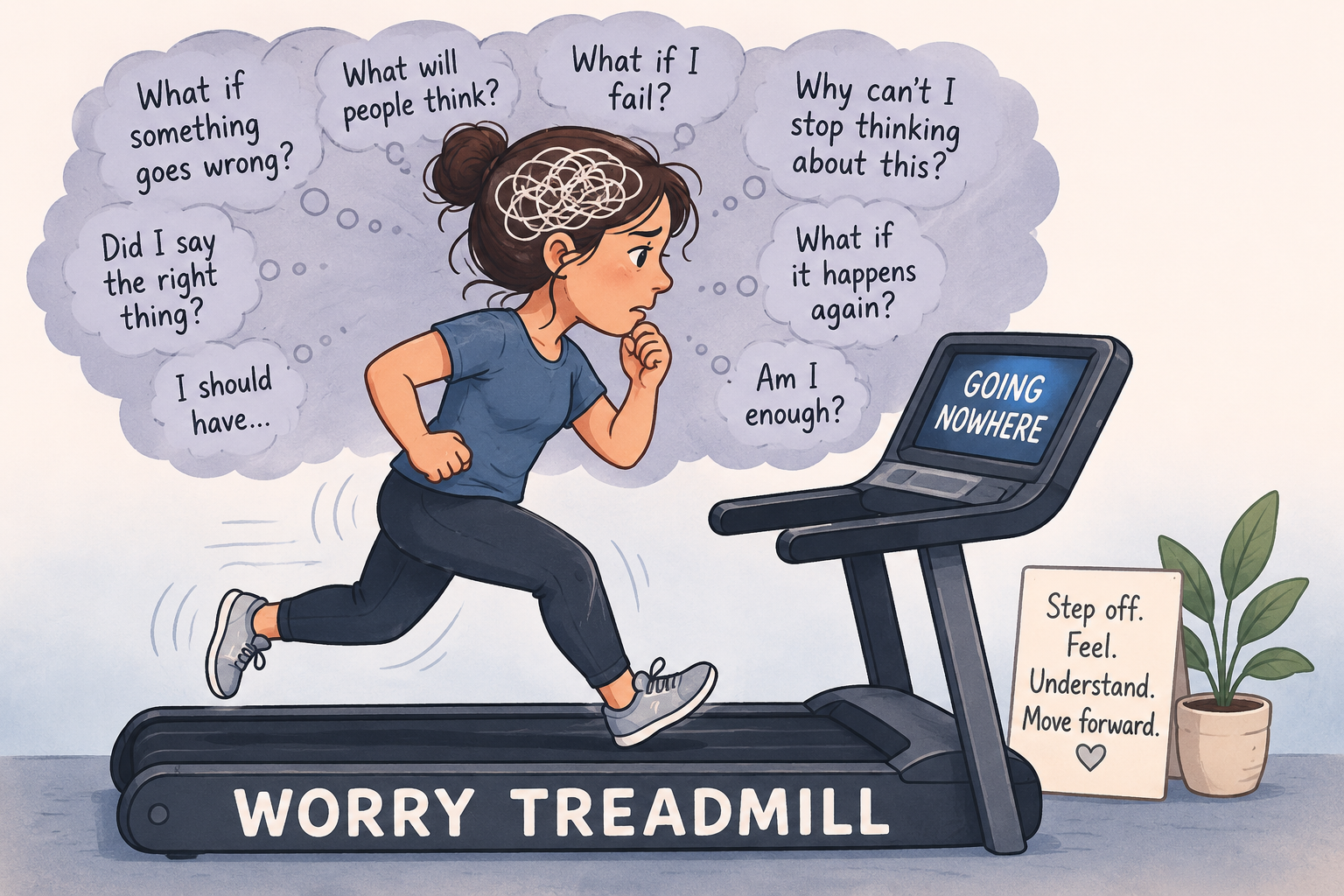
According to cognitive avoidance theory, worry isn't simply something that happens to us. It may also serve a psychological purpose.When we're faced with uncertainty or emotionally difficult situations, we naturally experience feelings such as fear, sadness, disappointment, guilt, or frustration. These emotions can be uncomfortable, and most of us would rather not experience them. So, instead of sitting with those emotions, we jump on the worry treadmill
We replay conversations.
We imagine different outcomes.
We mentally rehearse every possible "what if."
We analyze situations from every angle.
Although it feels like we're solving the problem, we may actually be avoiding the emotions that triggered the worry in the first place.
Why Worry Feels Productive
One way to think about worry is to imagine walking on a treadmill. While we're on it, we're moving, expending energy, and working hard, but we aren't actually getting anywhere.
Excessive worry usually works the same way.
We can spend hours mentally going over the same situation without arriving at a solution. At the same time, because our minds are so active, it feels as though we're accomplishing something. Worry creates a sense that we're taking action and gaining control over the situation, even if all we’re doing is just thinking about the same problem over and over. That’s why people who struggle with anxiety talk about being tired; chronic worry and overthinking feel exhausting. They take up a huge amount of mental energy and usually don’t help us solve the problem.
The other problem is that we never deal with the emotions underneath the worry. If you’re worrying about an upcoming medical test, you may realize, if you sit with yourself, that underneath the worry is a deep fear and some sadness about the possibility of loss if the worst possible outcome comes true. Someone who can't stop thinking about a conflict with a friend may find that what they're really feeling is sadness, disappointment, or even grief about the loss of the relationship. As long as we remain focused on the worry itself, we never get a chance to fully process those underlying emotions.
Why Worry Can Become a Habit
Another reason chronic worry can be so difficult to change is that it often becomes reinforcing.
Over time, many of us start to believe that worrying helps prevent bad things from happening. For example, we may think, "I'm glad I worried about that meeting because I remembered to prepare," or "I worried about forgetting my appointment, and I didn't forget."
Over time, the brain begins to connect worrying with good outcomes. It starts to feel as though the worry itself keeps us safe.
In reality, it may have been our actions, not the worrying, that made the difference. Preparing for the meeting, setting a reminder, or checking the calendar are helpful behaviors. We’re not saying that you stop taking care of the things that you need to take care of. But hours of repetitive worrying, however, often add little beyond increasing our distress.
Because we can't know for certain what would have happened otherwise, the brain learns that worrying feels protective, making it even harder to stop.
What Can We Do Instead?
If you notice yourself going over the same thoughts repeatedly, it may be helpful to pause and ask yourself a different question. Instead of asking, "How do I stop worrying?" try asking, "What am I feeling underneath this?" Am I afraid? Am I sad? Am I disappointed? Am I overwhelmed?
Am I afraid of failing? Am I afraid of losing something that's important to me? These questions shift our attention away from the worry itself and toward the emotions that may be driving it. Give yourself space to sit with those feelings and really feel them. If you’re someone who tends to struggle with identifying your emotions, it can help to try to name where they’re showing up on your body.
When we give ourselves space to acknowledge your emotions, it doesn't mean the emotions suddenly become comfortable. They may still be painful. But as we become more willing to acknowledge and feel our feelings rather than moving up to our heads to think about them, we give ourselves the chance to learn that emotions naturally rise and fall over time. We also learn something equally important: we can tolerate difficult emotions without becoming consumed by them.
When you acknowledge those emotions, it also helps you think more clearly about the situation. You’re able to better distinguish between the things you can control that will actually improve the situation, and, just as importantly, the things you can't control.
Moving Forward
Chronic worry is one of the most common symptoms of anxiety, but it may also serve a purpose. According to cognitive avoidance theory, worry can become a way of avoiding emotions that feel uncomfortable or overwhelming. Although worrying often creates a temporary sense of control, it may keep us from processing the feelings underneath it.
Learning to recognize when we're stuck in repetitive worry and becoming curious about the emotions beneath it can be an important step in breaking that cycle. Like many patterns associated with anxiety, this takes practice. Over time many of us find that we no longer need to spend as much time on the treadmill of worry because we’re becoming more comfortable experiencing emotions we used to work at avoiding.
Anxiety Therapy in Laredo, TX
At Chanderbhan Psychological Services, we provide evidence-based anxiety therapy in Laredo, TX, as well as online therapy throughout South Texas. Our team is trained in the therapies that have been found to be most effective for treating anxiety disorders, including CBT. We help clients understand the patterns of thinking and behavior that contribute to anxiety and develop practical strategies for responding differently to chronic worry.
-
Knowing you're overthinking doesn't automatically stop the process. For many people, chronic worry becomes a habit that creates the illusion of solving problems or preventing bad outcomes. Learning to recognize the emotions beneath the worry and responding differently can help break that cycle.
-
Yes. Cognitive Behavioral Therapy (CBT) is one of the most effective treatments for chronic worry and anxiety disorders. Therapy can help you identify patterns of thinking and behavior that maintain anxiety while teaching practical skills for responding differently.
-
If worry feels difficult to control, lasts for several months, causes significant distress, or interferes with your work, relationships, sleep, or overall quality of life, it may be time to speak with a mental health professional. Early treatment can help prevent anxiety from becoming more disruptive over time.