

Why Do New Year’s Resolutions Fail And What Actually Helps People Change
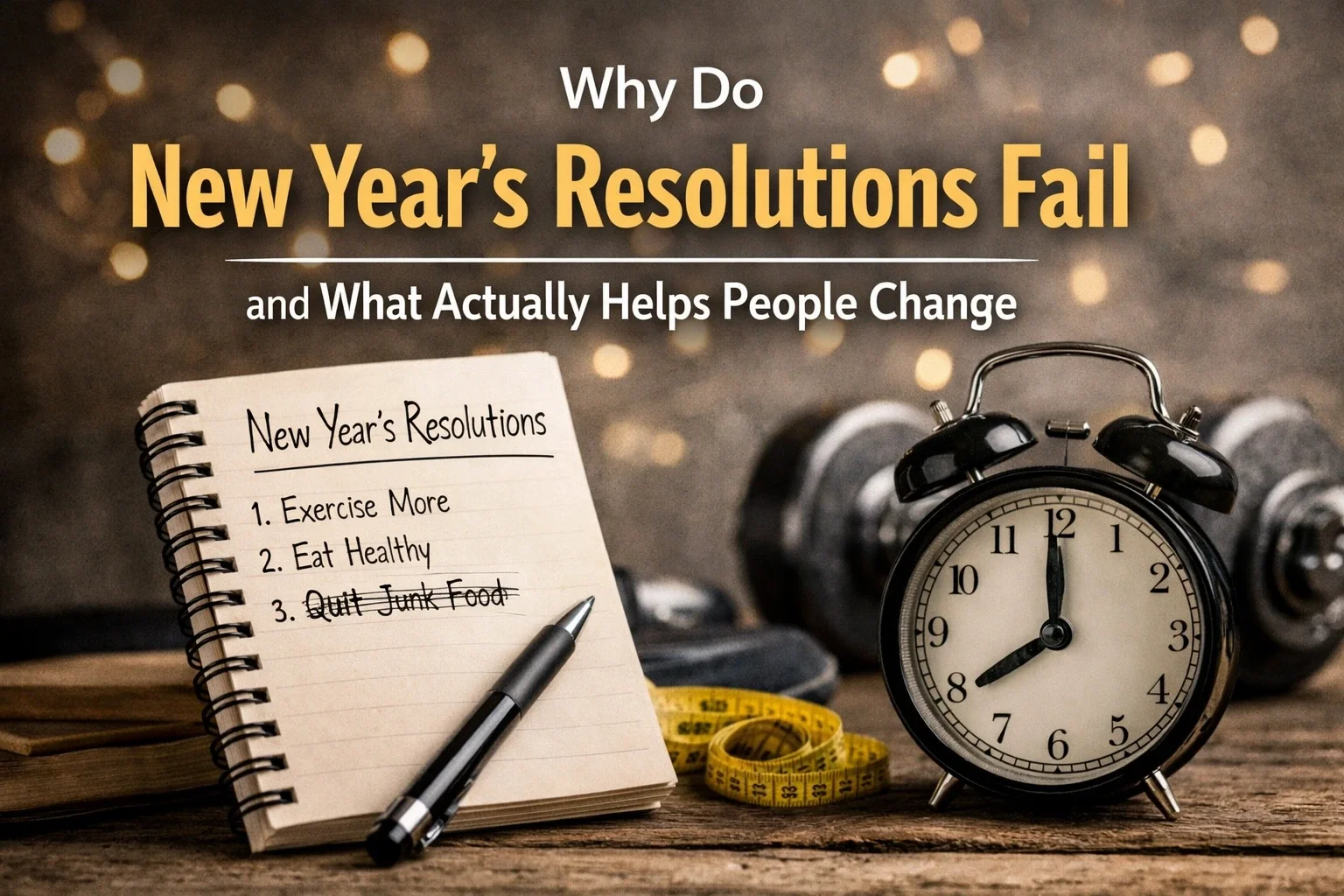
A few weeks into January, something usually shifts. The gym gets quieter. The new notebook with the carefully written goals is already half ignored. It’s not dramatic. It’s more like a quiet deflation. You’re still the same person, dealing with the same days, and suddenly the big energy of “this year will be different” feels far away. Understand that what people feel then isn’t laziness or failure. It’s confusion. You meant it, you really did. So why does it feel harder now than it did on January 1st? That question, asked quietly, sometimes with shame attached, is at the heart of why New Year’s resolutions fail.
Good Intentions Aren’t the Problem
Most resolutions don’t fall apart because people don’t care enough. If anything, they fail because people care a lot. They want relief, change, and growth. They want to feel different in their own lives. But intention is a strange thing. It feels powerful in the moment. It feels like a promise that should carry you forward on its own. And then life keeps happening. Work deadlines don’t soften. Old habits still feel familiar at the end of a long day. Stress shows up uninvited. Intention doesn’t disappear, but it stops being enough. That’s often when people start asking themselves harsh questions. Why can’t I just do this? Why does everyone else seem to manage? This is usually where the story about why people can’t maintain resolutions starts to turn inward, into something personal and painful.
Motivation Has a Short Shelf Life
Motivation is exciting, but it’s not durable. It’s like adrenaline. It spikes when something feels new or symbolic, like the start of a year, and then it fades. That fading doesn’t mean you don’t want the change anymore. It just means your nervous system has returned to normal. A lot of people secretly believe that if a goal really matters, motivation should stay high. When it doesn’t, they assume the goal was wrong or they were weak. But motivation was never designed to be permanent. It’s a spark, not a fuel source. This is where the conversation about how to stick to New Year’s resolutions usually goes wrong. We keep trying to revive motivation instead of asking what can carry us when motivation is gone.
Willpower Gets Too Much Credit
There’s a popular idea that change is mostly about discipline. If you want something badly enough, you’ll force yourself to do it. But willpower is fragile. It depends on sleep, stress levels, emotional load, and about a hundred invisible factors. By the end of a long day, willpower is often already spent on things that don’t look like choices: responding politely, making decisions, holding yourself together. Asking it to also overhaul your life is a lot. This is one reason the psychology of behavior change matters more than we like to admit. People don’t fail because they lack character. They struggle because they’re trying to change behavior without changing the conditions around that behavior.
The Quiet Power of Environment and Identity
Change sticks better when it doesn’t rely on constant self-control. Small shifts in environment, what’s nearby, what’s easy, what’s expected, do more than big declarations. So does identity. If you’re trying to act like a different person without seeing yourself as that person, it’s exhausting. There’s a subtle difference between “I’m trying to exercise” and “I’m someone who moves when I’m stressed.” One feels temporary. The other feels like it belongs to you. This isn’t about pretending or positive affirmations. It’s about noticing moments when you already act in alignment with the change you want, and letting those moments count. That’s often what helps people change habits more than grand plans.
Change Happens Slower Than We Expect
Another quiet reason resolutions collapse is timing. We expect noticeable results quickly. When they don’t come, doubt creeps in, “Maybe this isn’t working” or “Maybe I’m doing it wrong”. But real change often shows up subtly at first. You respond a little differently to stress. You pause instead of reacting. You make a choice once that you didn’t before. These moments don’t feel like success, so they’re easy to dismiss. Yet this slow accumulation is usually how people actually learn how to achieve personal goals. Not through dramatic transformations, but through repeated, almost boring consistency that eventually feels normal.
How We Support Meaningful Change
At Chanderbhan Psychological Services, we believe change happens when care feels personal, steady, and grounded in real life. We are a trusted group practice in Laredo, TX, offering therapy and psychological evaluations rooted in clinical expertise, ethical care, and compassion. Serving individuals across South Texas, we provide in-person and online therapy, and individualized treatment that respects your pace while supporting lasting emotional growth.
Where Therapy Fits In
Therapy doesn’t magically make change easy. What it can do is slow things down enough for you to see what’s really happening. Patterns that feel like personal flaws often turn out to be understandable responses to old situations. When someone works with a therapist around goals, the focus often shifts from “Why can’t I do this?” to “What happens right before I stop?” That question opens space. It brings curiosity instead of judgment.
Over time, therapy can support change by helping people notice their internal signals, tolerate discomfort without panicking, and choose responses instead of defaulting to habits. That support can matter a lot when motivation fades. At Chanderbhan Psychological Services in Laredo, TX, we work closely with individuals across South Texas to gently unpack these patterns through ethical, clinically grounded therapy, whether in person or through secure online sessions.
A Different Way to Think About Resolution Failure
We don’t think most resolutions fail. We think they reveal something. They show us where we overestimate willpower, underestimate context, or ask too much, too fast. They highlight the gap between who we are when we make promises and who we are when life is ordinary. Seen this way, abandoning a resolution isn’t proof of failure. It’s information. And information can be used, if you’re willing to look at it without turning it into a verdict on yourself. Change that lasts rarely feels heroic. It feels practical, a little messy, and surprisingly quiet.
-
They often rely on motivation and willpower without accounting for stress, routine, and environment. When the initial energy fades, there’s nothing sturdy underneath to hold the change in place.
-
Small, repeatable actions that fit into real life, along with changes in environment and self-understanding. Change lasts when it feels sustainable, not impressive.
-
Therapy helps people understand the emotional and psychological patterns that interfere with change. It creates space to explore resistance, fear, and habits without judgment, which makes new choices easier to practice.
-
Stress, identity, emotional regulation, past experiences, and expectations all play a role. Habits form more easily when they reduce effort or discomfort rather than add to it.
-
Staying motivated isn’t really the goal. Building systems and self-compassion that carry you when motivation drops tends to work better than trying to keep motivation high all the time.