

Managing Chronic Stress in First Responders: Practical Strategies
Chanderbhan Psychological Services
Part 2 of a Two-Part Series on Chronic Stress in First Responders

As National Police Week begins, we want to take a moment to acknowledge and thank law enforcement officers for the work you do. We extend a special thank you to the officers serving Laredo and the broader South Texas community.
In our previous post, we discussed how chronic stress develops in first responder work and how it often goes unnoticed. It’s not always one critical incident. More often, it’s the accumulation of ongoing demands, especially when your system doesn’t fully power down between shifts.
In this post, we’re going to focus on what you can actually do about it.
Many people assume stress management means things need to calm down first. In reality, resilience is built while life is still demanding. You may not be able to change the nature of the job, but you can influence how your body and mind respond to it.
The Most Important Shift: What You Can and Can’t Control
Let’s start here, because this is the core of everything.
There are parts of the job you don’t control:
schedules
call volume
staffing issues
the situations you walk into
Those are built into the work.
But there are also areas where you do have influence, and this is where stress management actually happens.
What You Can Control
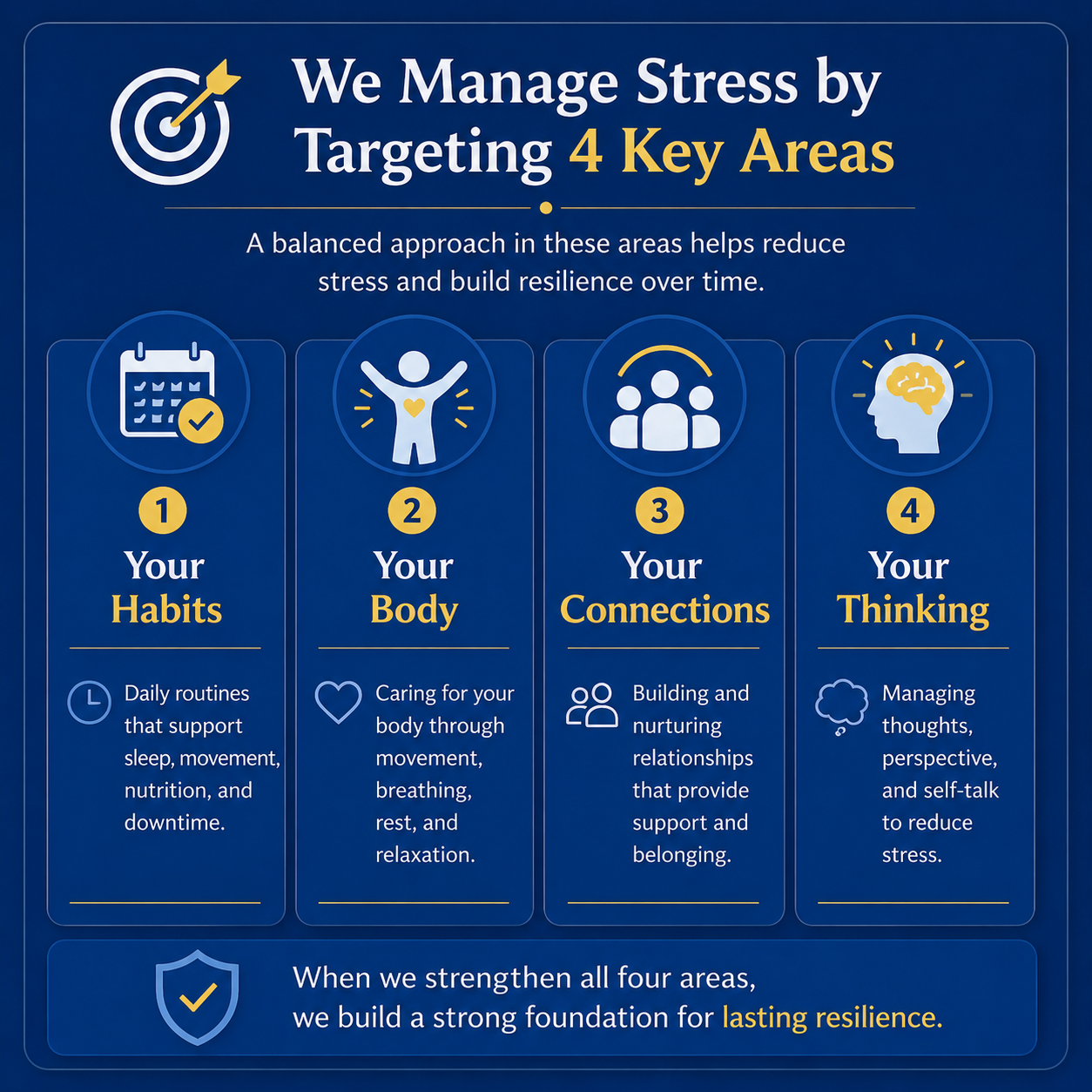
Build Your Foundation: Habits Matter
You can think of this as building an “emotional bank account.” The more consistently you invest in these areas, the more capacity you have when stress shows up.
A simple way to think about it: imagine your car suddenly needs four new tires.
If you don’t have any savings, that situation becomes stressful very quickly. Now you’re scrambling, worrying, and trying to figure out how to cover it.
But if you’ve built up some savings, it’s still an inconvenience, but it’s manageable. You handle it and move on.
Chronic stress works the same way. When your system has no reserves, even everyday stressors feel overwhelming. But when you’ve been consistently investing in sleep, exercise, and recovery, you have more capacity to handle what comes your way.
Sleep
Sleep is one of the most important and most disrupted areas for first responders.
When you’re getting quality sleep:
your stress hormones come down
your thinking is clearer
your emotional reactions are more regulated
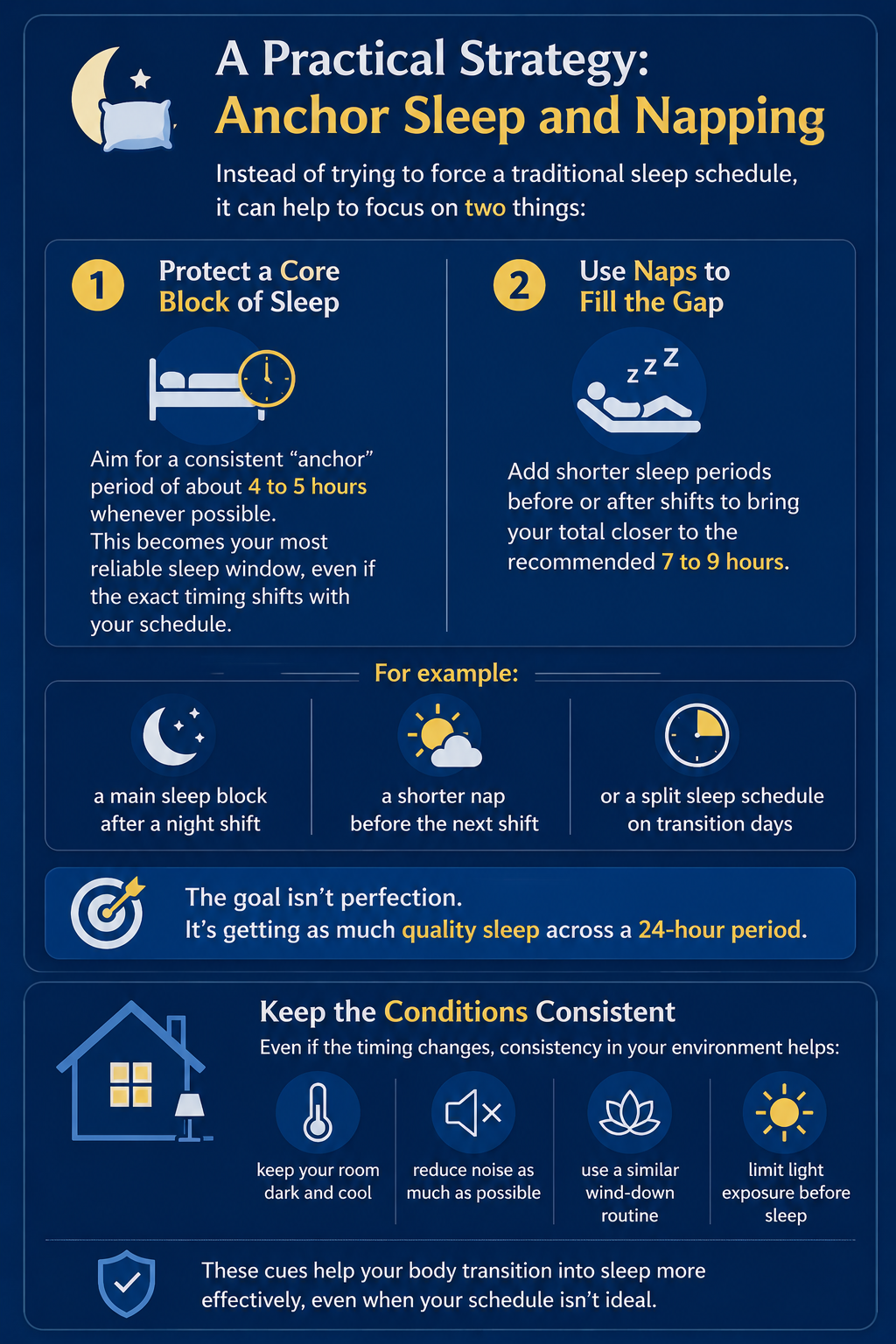
Most adults need about 7 to 9 hours, but increasingly research tells us that restful, restorative sleep, matters just as much as quantity.
A few practical adjustments:
keep your sleep and wake time within a consistent window when possible
slow your routine down 20 to 30 minutes before bed
reduce light and screens
give your body a signal that it’s time to shut down (e.g., shower, dim lights, listening to calm music)
You don’t need perfect sleep. You need better sleep than you’re getting now. If you can only change one thing in this area, it will make a big difference.
Sleep and Shift Work
For a lot of first responders, maintaining a consistent sleep schedule isn’t always possible. Rotating shifts, overnight work, and unpredictable calls can make a fixed bedtime unrealistic.
Research on shift work shows that irregular schedules disrupt the body’s natural circadian rhythm, which is why sleep often feels lighter, shorter, or less restful. It’s biological reality meeting your schedule.
So, the goal shifts from perfect consistency to protecting total sleep and recovery over time.
Exercise
Exercise is one of the most reliable ways to regulate stress.
It helps:
improve mood
lower anxiety
improve how your body responds to stress
A practical goal is about 30 minutes most days of the week, enough to get your heart rate up.
If you can do it outdoors, it’s better for mood. Consistency matters more than intensity. Throw a football around with your child, take a walk in the park, or spend time moving outdoors when you can; small amounts add up over time.
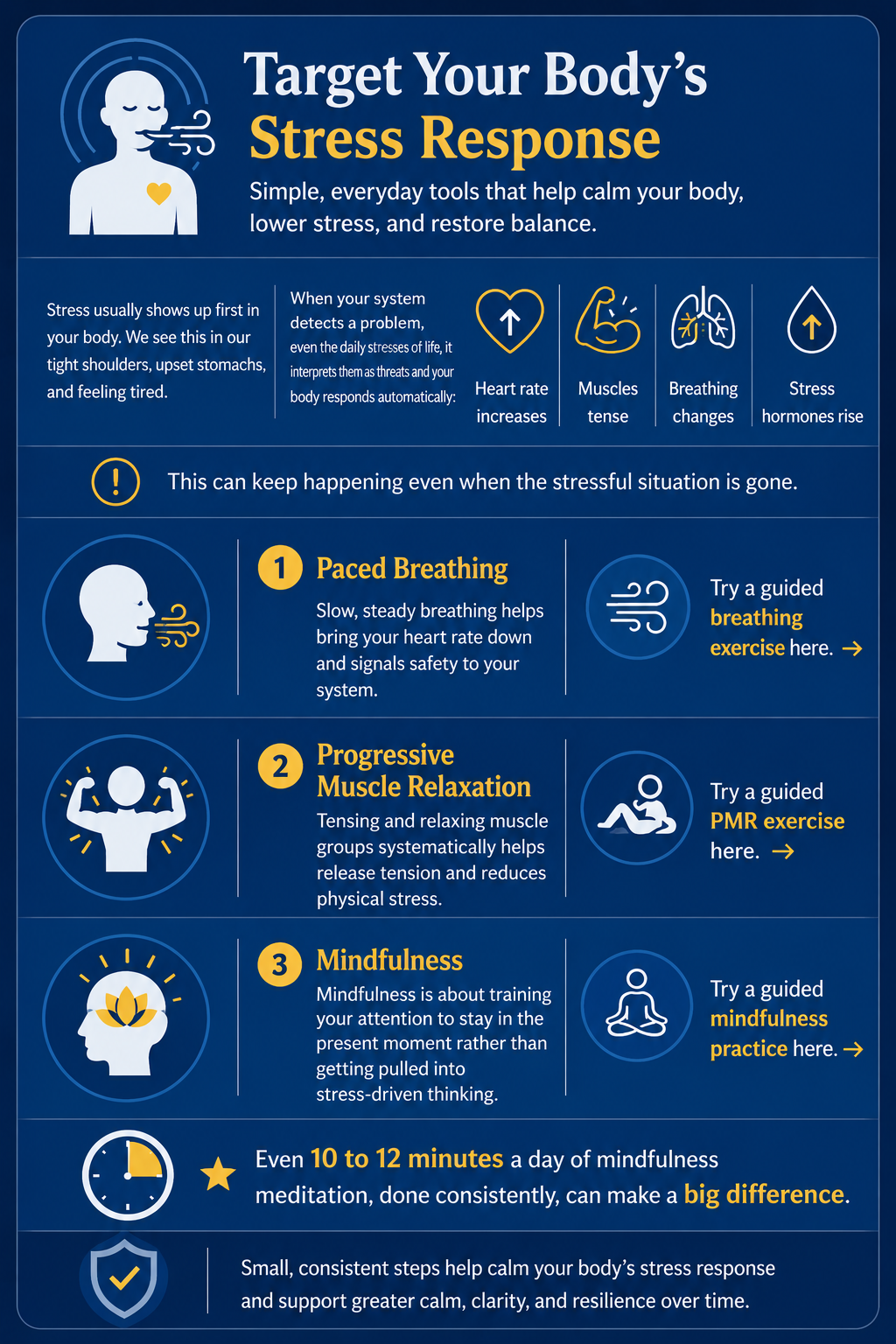
Target Your Body’s Stress Response
Stress usually shows up first in your body. We see this in our tight shoulders, upset stomachs, and feeling tired.
When your system detects a problem, even the daily stresses of life, it interprets it as a threat and your body responds automatically:
heart rate increases
muscles tense
breathing changes
stress hormones rise
This can keep happening even when the stressful situation is gone.
That’s why one of the most effective ways to manage chronic stress is to calm the body’s stress response.
Stay Connected, Even When You Don’t Feel Like It
When stress builds, most people pull back.
We tend to keep to ourselves, avoid conversations, and just try to decompress alone. The problem is that isolation tends to make stress worse over time.
Connection does the opposite. It helps:
regulate your system
lower stress hormones
improve mood
This often means doing the opposite of what you feel like doing.
check in with someone
talk briefly with a colleague
stay engaged with your team
It doesn’t have to be deep. It just has to be consistent.
Pay Attention to Your Self-Talk
Chronic stress affects how we think, and those thoughts can either help or hurt.
You might notice thoughts like:
“This always happens to me.”
“We’re never going to catch up.”
“This shouldn’t bother me.”
These tend to increase frustration and make it harder to respond effectively.
A more useful approach:
Catch it Notice when you feel frustrated, overwhelmed, or irritated.
Check it Ask yourself what the evidence is. Is this completely accurate?
Reframe it Shift to something more balanced:
“This is a lot right now, but I can handle it.”
“We’re behind, but things shift. Let me focus on what I can control.”
Refocus Bring your attention back to the present:
What’s one thing I can do right now that helps?
This isn’t about being overly positive. It’s about staying balanced.
Key Takeaways
Chronic stress is part of the job. It’s not something you eliminate, but it is something you can manage.
The goal isn’t perfection. It’s creating enough recovery to offset ongoing demands.
Small, consistent changes in sleep, exercise, physiology, connection, and thinking can make a real difference over time.
Taking care of your mental health supports your ability to perform, make decisions, and stay present in your work and your life.
Resources
Leaves on a Stream (for observing thoughts):https://www.youtube.com/watch?v=-j4AyHpXQ8E
Body scan meditation: https://www.youtube.com/watch?v=5mOZMxVKmiY
Progressive muscle relaxation (PMR):https://www.youtube.com/watch?v=SNqYG95j_UQ
Diaphragmatic Breathing/Tactical Breathing:https://www.youtube.com/watch?v=GZzhk9jEkkI&t=90s(4:30: Tactical Breathing)
Support for First Responders in Laredo and South Texas
At Chanderbhan Psychological Services, we provide evidence-based therapy for first responders in Laredo and across South Texas. We work with law enforcement, fire service, EMS, and federal personnel experiencing chronic stress, sleep disruption, irritability, emotional numbing, or difficulty shutting off after work.
Therapy doesn’t have to mean something is wrong. Many high-functioning professionals seek support early to protect performance, relationships, and long-term well-being.
If you’re wondering whether counseling for chronic stress could help, we’re available to talk through your questions and help you determine the right next step.
If you’re wondering whether counseling for chronic stress or first responder burnout could help, we’re available to answer your questions and help you determine the right next step. You can reach out through the Contact Form on our website.
-
Some level of stress comes with first responder work, especially in high-demand environments. However, chronic stress that never fully shuts off can begin to affect sleep, mood, concentration, relationships, and physical health over time. The goal is not to eliminate stress completely, but to manage it in a way that supports long-term functioning and recovery.
-
Common signs include irritability, emotional exhaustion, sleep problems, muscle tension, fatigue, difficulty concentrating, feeling “on edge,” or withdrawing from other people. For many first responders, these changes happen gradually and can become easy to overlook.
-
While you may not be able to control schedules, staffing shortages, or difficult calls, there are still areas that can improve resilience over time. Sleep, exercise, stress-regulation skills, supportive relationships, and balanced thinking patterns can all help reduce the long-term impact of chronic stress. Small, consistent changes often matter more than big, dramatic ones and small changes are easier to keep up over time.